
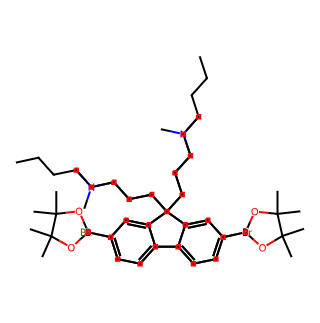
PFN CAS 673474-74-3
Identification
CAS Number
673474-74-3
Name
PFN
Synonyms
3,3′-(2,7-Dibrom-9H-fluoren-9,9-diyl)bis(N,N-dimethyl-1-propanamin) –2,2′-(9,9-dioctyl-9H-fluoren-2,7-diyl)bis(4,4,5,5-tetramethyl-1,3,2-dioxaborolan) (1:1)[German][ACD/IUPAC Name]
3,3′-(2,7-Dibromo-9H-fluorene-9,9-diyl)bis(N,N-dimethyl-1-propanamine) – 2,2′-(9,9-dioctyl-9H-fluorene-2,7-diyl)bis(4,4,5,5-tetramethyl-1,3,2-dioxaborolane) (1:1)[ACD/IUPAC Name]
3,3′-(2,7-Dibromo-9H-fluorène-9,9-diyl)bis(N,N-diméthyl-1-propanamine) – 2,2′-(9,9-dioctyl-9H-fluorène-2,7-diyl)bis(4,4,5,5-tétraméthyl-1,3,2-dioxaborolane) (1:1)[French][ACD/IUPAC Name]
9H-Fluorene-9,9-dipropanamine, 2,7-dibromo-N~9~,N~9~,N~9~,N~9~-tetramethyl-, compd. with 2,2′-(9,9-dioctyl-9H-fluorene-2,7-diyl)bis4,4,5,5-tetramethyl-1,3,2-dioxaborolane
SMILES
CCCCCCCCC1(CCCCCCCC)c2cc(B3OC(C)(C)C(C)(C)O3)ccc2-c2ccc(B3OC(C)(C)C(C)(C)O3)cc21.CN(C)CCCC1(CCCN(C)C)c2cc(Br)ccc2-c2ccc(Br)cc21
StdInChI
InChI=1S/C41H64B2O4.C23H30Br2N2/c1-11-13-15-17-19-21-27-41(28-22-20-18-16-14-12-2)35-29-31(42-44-37(3,4)38(5,6)45-42)23-25-33(35)34-26-24-32(30-36(34)41)43-46-39(7,8)40(9,10)47-43;1-26(2)13-5-11-23(12-6-14-27(3)4)21-15-17(24)7-9-19(21)20-10-8-18(25)16-22(20)23/h23-26,29-30H,11-22,27-28H2,1-10H3;7-10,15-16H,5-6,11-14H2,1-4H3
StdInChIKey
KFVHEDPARUQSLK-UHFFFAOYSA-N
Molecular Formula
C64H94B2Br2N2O4
Molecular Weight
1136.898
Properties
Appearance
Powder
Safety Data
RIDADR
NONH for all modes of transport
WGK Germany
3
Specifications and Other Information of Our PFN CAS 673474-74-3
Purity
99% min
Mw
Mw>10000
Shelf Life
2 years
Storage
Under room temperature away from light
Known Application
- Interface modification material (interface layer)
Used as electron transport layer (ETL) or cathode interface layer in organic photovoltaic cells (OPV) and organic light-emitting diodes (OLED) to improve the electron injection efficiency of the device. - Improve charge transfer efficiency and device stability
PFN can adjust the work function matching between the electrode and the organic layer, thereby improving the photoelectric conversion efficiency and device life.
Links
This product is developed by our R&D company Warshel Chemical Ltd (https://www.warshel.com/).
This product is developed by our R&D company Watson International Ltd (https://www.watson-int.com/).